
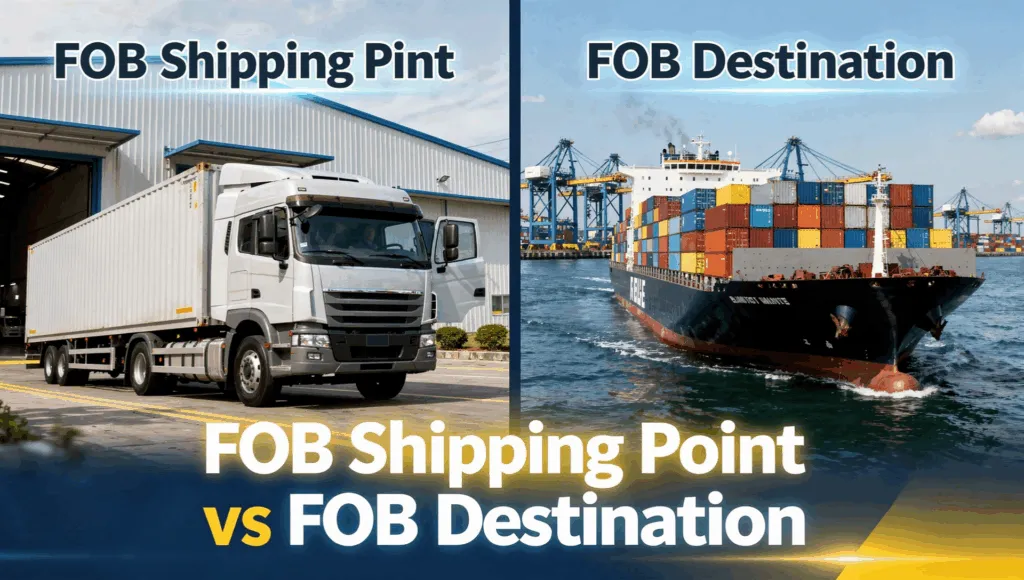

Understanding FOB Shipping Point vs FOB Destination
You’ve probably seen “FOB” on invoices and wondered what it means. FOB stands for “Free On Board,” a term that originated in the shipping industry during maritime trade. This historical context is essential, as it determines ownership and responsibility for goods during transportation. Today, FOB is crucial in modern commerce, both domestically and internationally, as it clarifies who pays freight costs and when ownership of goods transfers from seller to buyer. Understanding FOB shipping terms is vital for business owners because it impacts shipping agreements, costs, and risk management. Despite its age, the relevance of FOB terms remains strong, helping streamline shipping processes and protect the interests of all parties involved.
FOB Shipping Point vs FOB Destination: Key Differences
When choosing between FOB shipping point vs FOB destination, understanding their key differences is vital. With FOB shipping point, the buyer assumes ownership once the goods are loaded onto the shipping vessel. This means that the buyer is also responsible for the freight costs and any risk at the shipping point. On the other hand, with FOB destination, ownership and responsibility remain with the seller until the goods reach their final destination. This distinction affects accounting entries, shipping costs, and the overall risk associated with the goods during transit.
FOB Shipping Point
In a FOB shipping point agreement, the buyer pays for shipping and assumes ownership at the point of origin. This means that once the goods are on board the shipping vessel, the risk transfers to the buyer. The FOB shipping point accounting treatment reflects this transfer of ownership, impacting balance sheets and financial statements. Businesses must account for these costs and responsibilities correctly to maintain accurate financial records.
FOB Destination
Conversely, a FOB destination arrangement means the seller retains ownership and responsibility for the goods until they reach the buyer’s destination. This includes covering any freight costs associated with the shipping process. The FOB destination accounting entry involves recognizing the expenses only after the goods arrive, which can affect cash flow and accounting practices. For many businesses, choosing FOB destination is crucial to manage risk and ensure that goods are delivered in good condition before ownership transfers.
FOB Shipping Point vs FOB Destination: Key Differences
The key differences between FOB shipping point vs FOB destination hinge on ownership transfer and risk management. When you opt for FOB shipping point, the buyer assumes ownership as soon as the goods leave the seller’s shipping dock. This means the buyer is responsible for freight costs, risk of loss, and potential damages during transit.
In contrast, with FOB destination, the seller retains ownership and responsibility until the goods reach the buyer’s specified location. This setup not only alleviates the buyer’s risk but also impacts accounting entries, such as when to record the inventory on the balance sheet.
FOB Destination Accounting Entry
When using FOB destination terms, the accounting entry is made upon receipt of the goods. This means that inventory is recorded only after the goods arrive at the destination port, ensuring that any freight costs are accounted for by the seller until that point. This approach can help businesses manage their cash flow better since expenses are recorded later.
FOB Shipping Point Accounting Treatment
Conversely, for FOB shipping point, the accounting treatment requires that the goods be recorded as inventory as soon as they leave the seller’s premises. This means the buyer is responsible for recording the shipment as an asset, along with the associated shipping costs, which can affect the overall financial picture.
Choosing Between FOB Shipping Point vs FOB Destination
When deciding between FOB shipping point vs FOB destination, consider the following factors:
- Control Over the Shipping Process: If you prefer to manage the shipping process closely, FOB shipping point may be more suitable. It allows the buyer to control shipping methods and costs.
- Cost Considerations: Evaluate your budget and who pays freight. If the seller covers shipping under FOB destination, it may lead to lower upfront costs.
- Risk Reduction: If minimizing risk is a priority, choose FOB destination, as it transfers responsibility to the seller until delivery.
Who Pays Freight Costs?
BUYER pays all freight costs. In an FOB shipping point agreement, the buyer assumes ownership as soon as the goods leave the seller’s premises. This means that freight costs will typically appear as a separate line item on your invoice, which is essential for accurately calculating the true cost of inventory. It’s important to consider these hidden costs, as they can significantly affect your budget and overall expenses. Freight costs usually range from 10-20% of the order value, depending on the industry. For example, if you place a $500 order and incur a $75 freight charge, your total cost would be $575. Don’t forget to budget for freight! It can add 10-20% to small orders.
Ownership and Responsibility
In the case of FOB shipping point, ownership and risk are transferred to the buyer at the shipping point. This means that any damages or losses incurred during transit are the buyer’s responsibility. On the other hand, with FOB destination, the seller bears the risk until the goods reach the buyer’s location. This can significantly affect how businesses manage their shipping agreements and accounting treatments.
FOB Destination Accounting Entry
Understanding FOB destination vs shipping point also has implications for your accounting entries. For FOB destination shipments, the seller does not recognize revenue until the goods are delivered to the buyer. This accounting treatment ensures that the seller only accounts for sales when they have fulfilled their obligation. In contrast, for FOB shipping point, the seller recognizes revenue as soon as the goods leave their facility, which can impact financial statements and cash flow differently.
Freight Costs and Shipping Agreements
When evaluating FOB shipping terms, it’s essential to consider who pays the freight. Typically, under FOB shipping point terms, the buyer pays for shipping. This can lead to additional costs that may not have been initially budgeted. Knowing the shipping costs, including any freight charges, is vital for accurate financial forecasting. Understanding these shipping agreements can help businesses select the most cost-effective shipping method and manage expenses efficiently.
Accounting Treatment (Journal Entries)
When recording transactions involving FOB shipping point vs FOB destination, it’s essential to know when to record the entries. Generally, the recording occurs at the shipping date, not the arrival date. Here’s a step-by-step guide:
- Record the Merchandise Purchase: Debit Merchandise Inventory and credit Cash or Accounts Payable.
- Record Freight Costs: Debit Merchandise Inventory again for the freight charges, as these increase the inventory cost basis.
These entries demonstrate how freight costs are not expensed immediately but instead become part of the inventory cost, affecting cost of goods sold (COGS) later when the inventory is sold.
FOB Destination Explained
- Formal definition: “FOB Destination means ownership transfers when goods arrive at buyer’s location.”
- Plain English: “You don’t own it until it’s delivered to your door.”
- Seller retains ownership and risk during entire transit.
- Exact moment: When carrier delivers to your receiving dock/address.
- Insurance and risk remain with seller.
Unlike FOB Shipping Point where ownership transfers immediately, FOB Destination ensures that the seller retains both ownership and risk during the entire transit. Notice the key difference here: the goods are not considered yours until they reach your receiving dock. If that truck crashes on the highway under FOB Destination, the seller’s insurance pays because they still owned the goods. This can significantly impact your financial planning and accounting practices.
In terms of costs, while the seller handles freight costs until the goods reach their destination, it’s crucial to understand that the buyer is responsible for all shipping charges after delivery. Therefore, it’s essential to clearly define the shipping agreement in your contracts to avoid any confusion regarding who pays freight under FOB Destination.
For businesses engaged in international trade, understanding the nuances of FOB shipping terms, including FOB Destination, is crucial for compliance with regulations and ensuring a smooth transfer of goods. The International Chamber of Commerce outlines these terms, emphasizing the importance of clear definitions to prevent disputes.
When choosing between FOB shipping point vs FOB destination, consider the control each party has over the shipping process. Under FOB Destination, the seller is responsible for the transportation cost and risk until the goods reach their destination. This creates a more favorable scenario for buyers as they have less risk associated with potential damage during transit.
In summary, with FOB Destination, the transfer of ownership occurs at your receiving dock, and the seller bears the risk until that point. This contrasts sharply with FOB Shipping Point, where the buyer assumes ownership as soon as the goods leave the seller’s location. Understanding these key differences can help business owners make informed decisions when negotiating shipping terms.
Who Pays Freight Costs?
SELLER pays freight costs. While the buyer may see one inclusive price, this often includes the freight charges, which can make it seem like shipping is “free.” However, the seller likely built these costs into the product price—so you might not see a separate $75 freight charge, but it is included in the total price. This arrangement simplifies invoicing for the buyer, making it easier to understand overall expenses. It’s essential to remember, though, that just because FOB destination may appear cheaper, you should compare total prices with shipping point options to ensure you’re getting the best deal.
What Does FOB Destination Mean?
FOB destination means that the seller retains ownership and responsibility for the goods until they reach the buyer’s specified destination. Under this agreement, the seller pays for shipping and assumes all risks during transit. This arrangement can simplify the shipping process for buyers, as they do not have to manage freight costs or risks until the goods are delivered.
- Freight Costs: Who pays freight is a significant consideration. Under FOB shipping point, the buyer typically pays freight costs, while with FOB destination, the seller often covers these charges.
Visual Comparison of Accounting Entries
  FOB SHIPPING POINT:          FOB DESTINATION:
  Merch Inventory ... 500      Merch Inventory ... 500
       Cash/AP ........ 500          Cash/AP ........ 500
  Merch Inventory ... 75       (That's it—one entry!)
       Cash ........... 75
understanding these terms, businesses can optimize their shipping methods and manage costs effectively.
Cash Flow Impact
- FOB Shipping Point: Businesses must pay freight immediately or shortly after shipping, which can affect working capital.
- FOB Destination: Freight costs are often included in the vendor payment, allowing for more manageable cash flow.
- Understanding these cash timings is crucial for budgeting purposes; for example, with FOB Shipping Point, you may pay freight before paying the vendor if they offer Net 30 terms.
Insurance Implications
- FOB Shipping Point: Buyers need cargo insurance for transit. This responsibility means that if goods are damaged or lost, the buyer must file claims.
- FOB Destination: The seller’s insurance covers transit. This reduces the buyer’s risk, as the seller handles any issues during shipping.
- Consider the cost of insurance versus the benefit. For shipments over $2,000, verify insurance coverage regardless of FOB terms.
- Understand the insurance claim process for each term to streamline recovery in case of loss or damage.
H2: How to Choose Between FOB Shipping Point vs FOB Destination
When Buyers Prefer FOB Shipping Point
- Scenario 1: Large regular orders where shipping volume gets you better rates. By choosing FOB shipping point, the buyer assumes ownership and can leverage bulk shipping discounts.
- Scenario 2: Time-sensitive deliveries needing expedited shipping. Buyers can control the shipping process and ensure that goods reach their destination quickly.
- Scenario 3: Preferred carrier relationships (better tracking, reliability). When using FOB shipping point, buyers can choose their trusted carriers to manage logistics efficiently.
- Scenario 4: Orders over $5,000 where shipping control = significant savings. Buyers can negotiate better terms and save on shipping costs by opting for FOB shipping point.
- Scenario 5: Established supplier where you trust quality but want shipping control. This arrangement allows buyers to manage risks associated with ownership at the shipping point.
When Buyers Prefer FOB Destination
- FOB Destination makes sense when buyers face small occasional orders, particularly under $500, where shipping costs may complicate transactions. In such scenarios, simplicity prevails, allowing businesses to focus on their core operations.
- When dealing with new untested suppliers, FOB Destination allows the seller to assume transit risk, giving buyers peace of mind regarding ownership and responsibility until the goods reach their destination.
- For businesses lacking shipping expertise or warehouse staff, FOB Destination simplifies logistics, as the seller manages shipping, reducing potential complications.
- International orders with complex logistics also favor FOB Destination, as it mitigates the buyer’s risk and streamlines the shipping process.
- Lastly, limited accounting capacity makes FOB Destination appealing for small businesses, as it simplifies bookkeeping and reduces the need for intricate freight accounting entries.
QuickBooks Recording Examples
Understanding how to record transactions correctly is essential when evaluating FOB Shipping Point vs FOB Destination, especially because ownership, freight responsibility, and inventory value differ under each term. Below is a clear, step-by-step guide for QuickBooks users.
FOB Shipping Point (Buyer assumes ownership at shipment)
Under fob shipping point vs fob destination, QuickBooks requires extra steps because freight becomes part of inventory.
Enter FOB Terms on Purchase Order:
Click [+New] → Purchase Order → Enter Vendor → Add FOB Terms in the Memo field to document that ownership transfers at the shipping point.Create the Bill for Merchandise:
Click [+New] → Bill → Select Vendor → Items Tab. Enter each inventory item.
Important: In QuickBooks, always add FOB Shipping Point freight to the item cost, not the Expenses tab.Record Freight as Inventory Increase:
Click Items Tab → Add Line → Select “Freight-In” Item → Enter Freight Amount.
This increases inventory value and reflects that the buyer pays freight under a FOB shipping point agreement.Save Transaction to finalize your cost basis.
FOB Destination (Seller retains ownership until delivery)
The fob shipping point vs fob destination workflow is simpler here.
Record Receipt When Goods Arrive:
Click [+New] → Bill → Select Vendor → Items Tab → Enter Product Amount Only.
No freight line is needed because the seller pays freight under FOB destination.Save Transaction—One clean entry captures everything.
Common Accounting Mistakes
Understanding the difference between fob shipping point vs fob destination is essential for accurate financial reporting, yet many bookkeepers make recurring errors when handling ownership of goods, freight collect vs. freight prepaid, and the point at which ownership transfers. Below are the most frequent mistakes—and how to fix them.
Mistake #1: Recording freight as an operating expense under FOB Shipping Point
Why it’s wrong: Under FOB shipping point, the buyer assumes ownership when goods leave the seller, so freight should increase inventory cost—not hit the P&L.
How to fix: Reclassify freight to Merchandise Inventory, ensuring shipping rates reflect the correct cost from the shipping point.
Impact: Understates inventory and inflates expenses. These mistakes can distort your gross profit by 5–10% if you have significant freight costs.Mistake #2: Recording the purchase on the wrong date
FOB shipping point: Record at the ship date, when ownership transfers from the seller.
FOB destination: Record at the delivery date, when goods reach their destination FOB.
Why timing matters: Incorrect dates can misstate period-end inventory and COGS.Mistake #3: Not tracking FOB terms consistently
Why it’s wrong: Mixing shipping point or FOB origin with destination terms causes confusion about who is responsible for the goods.
How to fix: Record FOB terms in vendor profiles to clearly define ownership and responsibility.Mistake #4: Forgetting freight in the inventory cost basis
Why it’s wrong: Omitting freight affects COGS, gross profit, and understanding the true cost of goods at the point of shipment.
How to fix: Include all freight collected or prepaid in cost calculations for clarity between fob shipping point vs fob destination.
H2: FOB Terms for International Shipping (Incoterms)
How FOB Fits Into Incoterms 2020
For businesses comparing fob shipping point vs fob destination while expanding internationally, it’s important to understand how domestic FOB terms differ from the global standard known as Incoterms—the International Commercial Terms created by the ICC. FOB is only one of 11 official Incoterms, and unlike domestic free on board shipping rules, Incoterms address far more than the point at which ownership of the goods transfers.
Incoterms define who pays freight, who handles export documentation, who manages customs clearance, and who is responsible for the goods from the shipping point to the destination port. While domestic FOB shipping point vs FOB destination focuses on who pays freight and the risk at the shipping point, Incoterms provide a fuller picture for international ocean freight.
While domestic FOB covers ownership and freight, Incoterms also specify customs clearance, export documentation, and more, making them crucial for cross-border trade. Use Incoterms when shipping goods internationally—especially ocean freight—because they clearly define the differences between these two terms and the responsibilities placed on the seller and the buyer.
International Considerations
When comparing fob shipping point vs fob destination in global trade, businesses must understand that international shipping introduces additional responsibilities and risks beyond domestic free on board shipping rules. Here are key considerations for first-time importers and exporters:
Customs duties: Know when duties are paid, whether at the shipping point or the destination port, depending on the term FOB.
Import/export documentation: Missing documents can delay the transfer of ownership of the goods.
Currency exchange timing: Rate changes between the seller and the buyer can affect total shipping goods costs.
Port charges: Understand who pays for shipping-related port fees—some FOB destination places fees on the seller.
Longer transit times: Increased risk at the shipping point or destination, depending on who is responsible for the goods.
H2: Frequently Asked Questions
FAQ #1: Who pays shipping on FOB Destination?
The seller pays all shipping costs under FOB Destination terms. The buyer typically sees one combined amount on the invoice rather than a separate freight line, since the seller handles shipping goods to the destination. However, sellers often increase the product price to cover freight costs, even though it appears “included.” This can be advantageous for buyers who prefer predictable totals and reduced risk during transit, especially when comparing fob shipping point vs fob destination for budgeting purposes.
FAQ #2: When does ownership transfer with FOB Shipping Point?
Ownership transfers the moment goods leave the seller’s shipping dock or warehouse. Under fob shipping point vs fob destination ownership rules, the buyer owns the goods during transit and bears the risk at the shipping point. This also affects insurance because you become the legal owner while goods are still on the truck, meaning any loss or damage becomes your responsibility. In contrast, under FOB Destination, ownership transfers only when goods reach the buyer.
FAQ #3: How do you record FOB Shipping Point in accounting?
Record the purchase at the ship date with a debit to Merchandise Inventory and a credit to Cash or Accounts Payable. Record freight as a separate debit to Merchandise Inventory and credit to Cash, reflecting that the buyer pays freight under FOB shipping point, not FOB destination. Freight increases inventory value because it is part of getting goods to the point of use, not an operating expense. Both the product cost and freight become part of your inventory value.
FAQ #4: What’s better for buyers: FOB Shipping Point or FOB Destination?
It depends on your situation. FOB Shipping Point is often preferred when buyers want full control over shipping goods, access volume freight discounts, or take advantage of lower rates at the shipping point. FOB Destination works best when simplicity and risk reduction matter more, since the seller is responsible for goods to the destination. Always calculate total cost including freight for both terms before deciding, especially when comparing fob shipping point vs fob destination for budgeting and risk management.
FAQ #5: Do FOB terms affect sales tax?
Yes, FOB terms can affect sales tax because they determine where ownership transfers. In multi-state operations, the shipping point or destination can create different nexus implications. Sales tax is often calculated at the point where the seller transfers ownership of the goods to the buyer. Ownership location can trigger sales tax nexus in some states, leading to added reporting requirements. This can get complex—consult a tax professional for your specific situation before finalizing FOB terms.
FAQ #6: How does FOB impact inventory valuation?
FOB Shipping Point increases inventory value because freight costs are included. On your balance sheet, inventory is recorded at the cost of the goods plus freight when the buyer pays shipping under FOB shipping point. FOB Destination keeps inventory cleaner, since the seller pays for the shipping and no freight is added to the buyer’s inventory. This directly affects COGS: Under Shipping Point, $500 of goods with $75 freight = $575 inventory value, which increases cost when those goods are sold.
FAQ #7: Can you negotiate FOB terms with suppliers?
Yes, FOB terms are completely negotiable. When comparing fob shipping point vs fob destination, start the conversation early by asking suppliers which point of shipment they use and whether they can shift responsibility from the seller to the buyer—or vice versa. Suppliers often default to their preferred terms but will adjust for good customers, especially if you place regular orders or consolidate shipments. Always negotiate before finalizing the order, since the cost of FOB shipping point, who pays freight, and when ownership transfers must be agreed upon in advance.
CONCLUSION
Understanding fob shipping point vs fob destination is essential for controlling costs, managing risk, and improving your purchasing strategy. FOB Shipping Point transfers ownership at the seller’s dock and the buyer pays freight, while FOB Destination transfers ownership at the buyer’s dock and the seller pays freight. Neither option is universally better—each works in different situations depending on who should assume responsibility for the goods and when.
You now understand FOB terms better than most business owners. This knowledge gives you the confidence to negotiate stronger supplier agreements, avoid unexpected freight charges, and recognize how FOB terms influence profitability. Every purchasing decision—from who pays freight to when you take ownership—affects your margins, financial reporting, and overall supply chain efficiency.
Action Steps
Review your current supplier agreements for stated FOB terms.
Calculate whether you’re paying more than necessary in freight.
Identify opportunities to negotiate better terms with sellers or carriers.
Update accounting procedures to correctly record the point at which ownership transfers.
Consider your shipping volume to leverage potential carrier discounts.