
Learn Accounting

Learn accounting, key concepts and best practices at Daniel Sandler CPA. Develop strong financial skills through expert-led insights.

A vintage car showing visible wear and aging, illustrating how assets lose value over time and why understanding depreciation is important in accounting.
Uncategorized, Learn Accounting

Understanding Depreciation: 7 Essential Insights Into Its Powerful Financial Impact

Introduction to Depreciation Depreciation is a fundamental concept in accounting that pertains to the allocation of the cost of tangible assets over their useful lives. Understanding depreciation is essential because it allows businesses to systematically recognize the reduction in value of their assets and present a more accurate financial position. For students of accounting, business majors, and self-learners, understanding depreciation is a core competency that supports nearly every major accounting topic. This article delves into the intricacies of depreciation, covering its definition, its significance in accounting practices, the key inputs required for calculations, and common misconceptions that often arise when first understanding depreciation. By mastering these concepts, readers will develop a deeper appreciation for how depreciation affects financial statements, performance evaluation, and business decision-making. Key Inputs for Calculating Depreciation a. Cost of the Asset The first step in calculating depreciation is determining the cost of the asset. For anyone focused on understanding depreciation, this means recognizing that cost includes more than just the purchase price. It also encompasses shipping, installation, testing, and any modifications required to place the asset into service. Accurately recording asset cost is critical because effective understanding depreciation depends on a reliable starting point. Omitting relevant costs can distort depreciation calculations, potentially overstating profits and misleading stakeholders. Proper cost determination ensures depreciation reflects economic reality rather than accounting convenience. b. Salvage Value Salvage value, also known as residual value, represents the estimated amount an asset is expected to realize at the end of its useful life. When understanding depreciation, it is important to recognize how salvage value directly affects the total amount subject to depreciation. Higher salvage values reduce annual depreciation expense, while lower salvage values increase it. Estimating salvage value requires judgment, making it one of the more nuanced elements of understanding depreciation. Market conditions, asset type, industry norms, and historical experience all influence the estimate. Poor assumptions at this stage can materially affect reported earnings over time. c. Useful Life of Assets The useful life of an asset is the period over which it is expected to provide economic benefits to the business. A strong foundation in understanding depreciation requires distinguishing between physical life and economic usefulness. Assets may still function physically while no longer contributing value due to obsolescence or strategic shifts. Assets with longer useful lives spread depreciation expense over more periods, while shorter useful lives accelerate expense recognition. Accounting standards provide guidance, but understanding depreciation also requires applying professional judgment based on business context and historical usage. The Nature of Depreciation Estimates Why Depreciation is an Estimate Depreciation is inherently an estimate because it relies on assumptions about future usage, wear and tear, and technological relevance. Anyone serious about understanding depreciation must accept that precision is impossible and judgment is unavoidable. Rather than reflecting exact market value, depreciation provides a systematic method for allocating asset cost over time. This approach allows stakeholders to better understand an asset’s contribution to operations, reinforcing the broader purpose of understanding depreciation within financial reporting. Influence of Assumptions on Financial Statements Assumptions used in depreciation calculations can significantly influence financial results. Overstating useful life understates depreciation expense and inflates income, while understating useful life accelerates expense recognition. Understanding depreciation therefore includes understanding how managerial bias or poor estimates can distort performance metrics. Given these implications, businesses must regularly review and adjust their estimates to reflect changing circumstances accurately. This practice ensures compliance with accounting standards and helps maintain the integrity of financial reporting. Common Misconceptions in Understanding Depreciation Miscalculating Salvage Value A frequent misconception encountered when understanding depreciation is the belief that salvage value must be exact. In reality, it is an informed estimate based on available information, not a guaranteed outcome. This misunderstanding can lead to significant miscalculations in depreciation, affecting the accuracy of financial reporting. It is essential to review and update salvage values regularly to ensure that they remain relevant and reflective of current market conditions. Misunderstanding Useful Life of Assets Another common error in understanding depreciation is assuming that useful life equals physical lifespan. Economic usefulness may end far sooner due to innovation, competition, or strategic change. Therefore, it is crucial for students and business professionals to differentiate between an asset’s physical durability and its economic usefulness to avoid errors in depreciation calculations. Overlooking Accounting Depreciation Methods Many learners focus solely on straight-line depreciation, overlooking alternatives such as declining balance or units-of-production methods. A complete understanding depreciation includes recognizing how different methods affect expense timing and reported earnings. For instance, the straight-line method spreads the cost evenly over the useful life, while the declining balance method front-loads expenses. Understanding these methods empowers individuals to select the most appropriate one for their specific situation, ensuring accurate financial reporting. Visual Aids for Understanding Depreciation Diagrams and Charts Visual tools play an important role in understanding depreciation, especially for visual learners. Graphs showing book value declining over time help illustrate how depreciation operates across an asset’s useful life. Comparative charts displaying multiple depreciation methods further enhance understanding depreciation by showing how method choice influences reported income and asset values. Examples of Depreciation Calculations Concrete examples can clarify how depreciation is applied in practice. For instance, consider a company that purchases machinery for $10,000, estimates its salvage value at $1,000, and expects its useful life to be ten years. Using the straight-line method, the annual depreciation expense would be calculated as follows: Cost of Asset Salvage Value Useful Life (Years) Annual Depreciation Expense $10,000 $1,000 10 ($10,000 – $1,000) / 10 = $900 Working through examples like this helps students solidify their understanding depreciation and prepares them for real-world application. Conclusion Recap of Key Points Understanding depreciation is crucial for anyone involved in accounting or business. This article has covered the definition and importance of depreciation, the key inputs necessary for its calculation, the nature of estimates involved, and common misconceptions that can lead to errors. Additionally, visual aids and practical examples enhance comprehension, making the topic more accessible to all learners. Encouragement for Further Learning As you continue your accounting


A conceptual illustration representing the cost of plant assets under GAAP, showing how asset acquisition costs are measured, categorized, and prepared for depreciation.
Uncategorized, Learn Accounting

Real-World Examples of Computing the Cost of Plant Assets: A Step-by-Step Guide for Accounting Students and Small Business Owners

Introduction to Plant Assets and GAAP In the realm of accounting, understanding the cost of plant assets is paramount, particularly under Generally Accepted Accounting Principles (GAAP). The cost of plant assets determines how fixed assets are initially recorded and subsequently reported on financial statements. Plant assets, often referred to as fixed assets, include tangible items used in the production of goods and services with useful lives extending beyond one accounting period. Examples of plant assets include machinery, buildings, and land, all of which require careful measurement of the cost of plant assets at acquisition. Accurate determination of the cost of plant assets establishes the foundation for depreciation calculations, asset valuation, and reliable financial reporting. This article examines the components of the cost of plant assets, highlights common accounting errors, and provides real-world examples to clarify these concepts. Components of Acquisition Cost for Plant Assets Machinery Machinery often represents a significant portion of the cost of plant assets for manufacturing and production-based companies. The cost of plant assets related to machinery includes not only the purchase price but also import duties and all costs necessary to bring the machinery to its intended location and condition. Transportation fees, insurance during transit, and installation costs are all part of the cost of plant assets when machinery is acquired. Properly identifying these components ensures the machinery’s recorded cost of plant assets accurately reflects the total investment made by the business. Buildings When accounting for buildings, the cost of plant assets extends well beyond the purchase price of the structure. The cost of plant assets for buildings includes acquisition price, legal fees, title searches, and closing costs. Additionally, renovations or improvements made prior to placing the building into service are included in the cost of plant assets if they enhance the building’s value or usability. Accurately measuring the cost of plant assets for buildings ensures depreciation and asset valuation align with GAAP. Land Land is unique when analyzing the cost of plant assets because it is not depreciated. However, determining the cost of plant assets related to land remains critical. The cost of plant assets for land includes the purchase price, closing costs, and expenditures necessary to prepare the land for its intended use. Grading, clearing, filling, and demolition of old structures are all capitalized as part of the cost of plant assets for land. Proper classification ensures land is recorded correctly on the balance sheet. Land Improvements Land improvements represent a distinct category within the cost of plant assets framework. These improvements include items such as paving, fencing, lighting, and landscaping that enhance land usability. Unlike land itself, land improvements are depreciable. Therefore, identifying land improvements separately within the cost of plant assets allows for accurate depreciation calculations and financial reporting. Costs to be Capitalized Direct Costs Associated with Acquisition Capitalizing costs relates to recognizing expenses that provide future economic benefits. Direct costs associated with acquiring plant assets need to be documented meticulously. For instance, when a company purchases a delivery truck, the costs incurred during the purchase process—such as the negotiated price, transportation costs, and necessary modifications to meet operational needs—should all be included in the capitalized cost. Inducement Costs and Their Importance Inducement costs, though sometimes overlooked, are critical in establishing the overall acquisition cost. These may include any incentives or discounts received by the buyer as part of the purchasing agreement. Accurately recording these costs allows businesses to reflect the true value of the asset on their balance sheets and can influence future depreciation calculations. Installation and Testing Costs Installation and testing costs are integral to ensuring that an asset is ready for use. These costs should be included in the acquisition cost as they create value for the asset. For example, if a company purchases new manufacturing equipment, all expenses related to its installation, calibration, and initial testing should be capitalized, ensuring that the asset is reflected accurately in financial statements. Common Mistakes in Accounting for Fixed Assets Overlooking Non-Direct Costs One of the most prevalent errors in accounting for fixed assets is the oversight of non-direct costs. While direct costs are typically easy to identify, indirect costs—such as administrative expenses, financing costs, and maintenance during the installation phase—can often be forgotten. This can lead to underreporting the true acquisition cost of plant assets and result in inaccuracies in financial reporting. Misclassifying Expenses Misclassification of expenses can distort a company’s financial health. For example, small business owners might mistakenly categorize repairs or maintenance costs as capital expenditures instead of recognizing them as operational expenses. Understanding the distinction between these categories is vital, as capital expenditures lead to asset creation on the balance sheet while operational expenses impact the income statement directly. Ignoring Depreciation Implications Another common pitfall is neglecting the implications of depreciation when calculating acquisition costs. Depreciation affects the asset’s book value and the company’s net income over time. Misunderstanding how to factor depreciation into the costs can lead to financial statements that do not accurately reflect the company’s true financial position, which is detrimental for stakeholders relying on these reports. Real-World Examples of Plant Asset Acquisition Cost Example 1: Acquisition of Machinery Consider a manufacturing company that purchases a new lathe for $50,000. In addition to the purchase price, the company incurs $5,000 in transportation costs and $2,000 for installation. Furthermore, the company pays $1,000 in insurance for the transportation of the lathe. In this case, the total acquisition cost of the lathe would be $58,000, which should be capitalized on the balance sheet. Example 2: Purchase and Improvement of a Building Imagine a business that acquires a building for $400,000. The company also spends $50,000 on renovations and $10,000 on legal fees associated with the purchase. The total capitalized cost for the building would then be $460,000, providing a clear picture of the investment made. This comprehensive approach ensures all relevant costs are reflected in the asset’s valuation. Example 3: Land Acquisition and Related Costs When a company buys a plot of land for $300,000, there could be additional

A stylized illustration of a character using a credit card at a mobile payment terminal, representing mobile payment accounting and transaction recording.
Learn Accounting

Credit Card and Mobile Payment Accounting: 7 Best Practices

Introduction In today’s fast-paced business environment, mobile payments have become an indispensable part of financial transactions. As more consumers prefer the convenience of mobile payment options such as Apple Pay, Google Pay, and various other digital wallets, business owners must ensure that their mobile payment accounting practices effectively accommodate this shift. Mobile payment accounting is crucial not only for maintaining proper financial records but also for ensuring compliance and maximizing profitability. This article delves into the comprehensive aspects of mobile payment accounting. We will explore everything from basic journal entries to the intricacies of fees and chargebacks, ultimately providing business owners, bookkeepers, accounting majors, online sellers, and financial staff with practical step-by-step guidelines for effective mobile payment accounting in the realm of transactions. Journal Entries for Credit Card and Mobile Payments Understanding Journal Entries Journal entries are the foundation of mobile payment accounting. They document every financial transaction within a business, ensuring that all income and expenses are recorded accurately. For mobile payments and credit card transactions, journal entries capture the sale, any applicable fees, and the net income that ultimately affects the business’s financial statements. Each entry must maintain the double-entry accounting system, meaning that every transaction affects at least two accounts. When handling mobile payments, it is essential to properly categorize the transactions. This includes identifying the revenue account, the cash or bank account receiving the funds, and any fees associated with the transaction. Properly structured journal entries for mobile payments ensure transparency and accuracy in financial reporting. Sample Journal Entries for Credit Card Sales When a customer makes a purchase using a credit card, the following journal entry may be utilized: Debit: Accounts Receivable (or Cash) $100 Credit: Sales Revenue $100 This entry reflects the sale of goods or services amounting to $100, as well as the corresponding increase in accounts receivable or cash, depending on the processing of the payment. If a fee is incurred, say 3% for credit card processing, an additional entry must be recorded: Debit: Merchant Fees Expense $3 Credit: Accounts Receivable (or Cash) $3 Sample Journal Entries for Mobile Payment Sales Mobile payments follow a similar structure. When a mobile payment accounting transaction occurs, the initial entry is: Debit: Accounts Receivable (or Cash) $100 Credit: Sales Revenue $100 Following this, if you incur a processing fee of 2.5%, the entry would be: Debit: Merchant Fees Expense $2.50 Credit: Accounts Receivable (or Cash) $2.50 Fees in Mobile Payment Processing Types of Fees Incurred Mobile payment processing often comes with various fees, which can affect a business’s overall profitability. Common types of fees include transaction fees, monthly service fees, chargeback fees, and cross-border fees. Transaction fees usually comprise a percentage of the transaction amount plus a flat fee, while monthly service fees are recurring costs associated with the payment service provider. Chargeback fees arise when a customer disputes a charge, and cross-border fees are applicable for international transactions. Understanding these fees is vital for accurate financial forecasting and budgeting. Businesses should regularly review their payment processor’s fee structure and seek competitive rates that align with their transaction volume and business needs. Impact of Fees on Profit Margins The cumulative effect of mobile payment processing fees can significantly impact profit margins. These fees often reduce the overall revenue received from sales, leading to a narrower profit margin. For instance, if a business sells a product for $100 but incurs $3 in transaction fees, the effective revenue is only $97. This emphasizes the importance of considering payment processing fees when setting prices and evaluating profitability. Furthermore, businesses must be vigilant about monitoring these fees over time, as they can change based on transaction volume, processing agreements, and market conditions. Regular analysis enables businesses to make informed decisions on whether to renegotiate with their payment processor or explore alternative providers. Recording Fees in Accounting To ensure accurate financial reporting, recording fees associated with mobile payment processing should follow a systematic approach. Fees should be documented as expenses in the accounting system, typically under ‘Merchant Fees‘ or ‘Payment Processing Fees.’ This allows businesses to track the total cost of accepting mobile payments and assess overall payment processing efficiency. A typical journal entry for recording fees might look like this: Debit: Merchant Fees Expense $3 Credit: Bank Account $3 By consistently recording these fees, businesses can gain valuable insights into their payment processing costs and how they affect profitability. Net vs Gross Settlement Definition of Net Settlement Net settlement refers to the process where payment processors deduct fees from the transaction amount before depositing the funds into the merchant’s account. For example, if a customer pays $100 and the processing fee is $3, the merchant receives $97. This method simplifies cash flow management, as the business only receives net amounts, reducing the need for separate fee tracking. Definition of Gross Settlement Gross settlement, on the other hand, involves the payment processor depositing the full transaction amount into the merchant’s account. The fees are then charged separately, usually on a scheduled basis. This allows for greater visibility of gross sales but requires more extensive tracking of fees for reconciliation. Businesses must decide which option better aligns with their accounting practices and cash flow needs. Choosing the Right Settlement Method The choice between net and gross settlement methods often depends on the size and complexity of the business. Smaller businesses may prefer net settlement for its simplicity, while larger organizations with significant transaction volumes may benefit from the detailed visibility provided by gross settlement. Ultimately, a thorough analysis of cash flow, reporting requirements, and processing fees should guide this decision. Understanding Chargebacks What is a Chargeback? A chargeback occurs when a customer disputes a transaction, prompting the credit card issuer to reverse the charge. This can happen for various reasons, including fraud, dissatisfaction with the product, or failure to deliver. Chargebacks can be costly for businesses, not only due to the loss of revenue but also because they often incur additional fees from payment processors. Understanding the chargeback process is essential for mitigating

Split-screen graphic comparing FOB Shipping Point and FOB Destination with cargo truck, cargo ship, cost arrows, and risk icons.
Learn Accounting

FOB Shipping Point vs Destination: Win Control

Understanding FOB Shipping Point vs FOB Destination You’ve probably seen “FOB” on invoices and wondered what it means. FOB stands for “Free On Board,” a term that originated in the shipping industry during maritime trade. This historical context is essential, as it determines ownership and responsibility for goods during transportation. Today, FOB is crucial in modern commerce, both domestically and internationally, as it clarifies who pays freight costs and when ownership of goods transfers from seller to buyer. Understanding FOB shipping terms is vital for business owners because it impacts shipping agreements, costs, and risk management. Despite its age, the relevance of FOB terms remains strong, helping streamline shipping processes and protect the interests of all parties involved. FOB Shipping Point vs FOB Destination: Key Differences When choosing between FOB shipping point vs FOB destination, understanding their key differences is vital. With FOB shipping point, the buyer assumes ownership once the goods are loaded onto the shipping vessel. This means that the buyer is also responsible for the freight costs and any risk at the shipping point. On the other hand, with FOB destination, ownership and responsibility remain with the seller until the goods reach their final destination. This distinction affects accounting entries, shipping costs, and the overall risk associated with the goods during transit. FOB Shipping Point In a FOB shipping point agreement, the buyer pays for shipping and assumes ownership at the point of origin. This means that once the goods are on board the shipping vessel, the risk transfers to the buyer. The FOB shipping point accounting treatment reflects this transfer of ownership, impacting balance sheets and financial statements. Businesses must account for these costs and responsibilities correctly to maintain accurate financial records. FOB Destination Conversely, a FOB destination arrangement means the seller retains ownership and responsibility for the goods until they reach the buyer’s destination. This includes covering any freight costs associated with the shipping process. The FOB destination accounting entry involves recognizing the expenses only after the goods arrive, which can affect cash flow and accounting practices. For many businesses, choosing FOB destination is crucial to manage risk and ensure that goods are delivered in good condition before ownership transfers. FOB Shipping Point vs FOB Destination: Key Differences The key differences between FOB shipping point vs FOB destination hinge on ownership transfer and risk management. When you opt for FOB shipping point, the buyer assumes ownership as soon as the goods leave the seller’s shipping dock. This means the buyer is responsible for freight costs, risk of loss, and potential damages during transit. In contrast, with FOB destination, the seller retains ownership and responsibility until the goods reach the buyer’s specified location. This setup not only alleviates the buyer’s risk but also impacts accounting entries, such as when to record the inventory on the balance sheet. FOB Destination Accounting Entry When using FOB destination terms, the accounting entry is made upon receipt of the goods. This means that inventory is recorded only after the goods arrive at the destination port, ensuring that any freight costs are accounted for by the seller until that point. This approach can help businesses manage their cash flow better since expenses are recorded later. FOB Shipping Point Accounting Treatment Conversely, for FOB shipping point, the accounting treatment requires that the goods be recorded as inventory as soon as they leave the seller’s premises. This means the buyer is responsible for recording the shipment as an asset, along with the associated shipping costs, which can affect the overall financial picture. Choosing Between FOB Shipping Point vs FOB Destination When deciding between FOB shipping point vs FOB destination, consider the following factors: Control Over the Shipping Process: If you prefer to manage the shipping process closely, FOB shipping point may be more suitable. It allows the buyer to control shipping methods and costs. Cost Considerations: Evaluate your budget and who pays freight. If the seller covers shipping under FOB destination, it may lead to lower upfront costs. Risk Reduction: If minimizing risk is a priority, choose FOB destination, as it transfers responsibility to the seller until delivery. Who Pays Freight Costs? BUYER pays all freight costs. In an FOB shipping point agreement, the buyer assumes ownership as soon as the goods leave the seller’s premises. This means that freight costs will typically appear as a separate line item on your invoice, which is essential for accurately calculating the true cost of inventory. It’s important to consider these hidden costs, as they can significantly affect your budget and overall expenses. Freight costs usually range from 10-20% of the order value, depending on the industry. For example, if you place a $500 order and incur a $75 freight charge, your total cost would be $575. Don’t forget to budget for freight! It can add 10-20% to small orders. Ownership and Responsibility In the case of FOB shipping point, ownership and risk are transferred to the buyer at the shipping point. This means that any damages or losses incurred during transit are the buyer’s responsibility. On the other hand, with FOB destination, the seller bears the risk until the goods reach the buyer’s location. This can significantly affect how businesses manage their shipping agreements and accounting treatments. FOB Destination Accounting Entry Understanding FOB destination vs shipping point also has implications for your accounting entries. For FOB destination shipments, the seller does not recognize revenue until the goods are delivered to the buyer. This accounting treatment ensures that the seller only accounts for sales when they have fulfilled their obligation. In contrast, for FOB shipping point, the seller recognizes revenue as soon as the goods leave their facility, which can impact financial statements and cash flow differently. Freight Costs and Shipping Agreements When evaluating FOB shipping terms, it’s essential to consider who pays the freight. Typically, under FOB shipping point terms, the buyer pays for shipping. This can lead to additional costs that may not have been initially budgeted. Knowing the shipping costs, including any freight charges, is vital for

Abstract concept of the accounting cycle represented by flowing binary data through a library of financial records, symbolizing digital accounting processes.
Uncategorized, Learn Accounting

Understanding the Accounting Cycle: 4 Steps to Breaking Down the Basics

Introduction to the Accounting Cycle The accounting cycle is fundamental in the world of finance and accounting. It encompasses the series of steps that businesses use to track their financial transactions and produce accurate financial statements. Understanding the accounting cycle is essential not just for aspiring accountants but also for students, educators, and anyone interested in managing finances effectively. This guide will break down the accounting cycle into its core components, providing clarity on each step along the way. This article aims to demystify the accounting cycle, explaining its significance and how each step interconnects. Whether you are a student looking to grasp basic accounting concepts or an educator seeking to impart knowledge, the following sections will provide valuable insights into this critical process. What is the Accounting Cycle? The accounting cycle is a systematic process that organizations use to record, classify, and summarize financial transactions. The cycle typically begins with the identification of source documents and concludes with the preparation of financial statements. Each phase plays a crucial role in ensuring that financial records are accurate and reliable, adhering to recognized accounting standards. At its core, the accounting cycle involves a series of steps that transform raw financial data into actionable insights, aiding in decision-making and strategic planning. By understanding the accounting cycle, individuals can better appreciate how businesses track their financial health and comply with regulatory requirements. Importance of Understanding the Accounting Cycle For students and educators alike, grasping the accounting cycle is vital for several reasons. First, it lays the foundation for advanced accounting practices, enabling learners to build upon basic concepts as they progress. Second, knowledge of the accounting cycle empowers individuals to analyze financial statements critically, facilitating informed decisions in personal finance or business management. Moreover, understanding the accounting cycle fosters transparency and accountability in financial reporting. For educators, teaching these concepts helps prepare students for real-world applications, making them more competitive in the job market. In an age of data-driven decision-making, a solid grasp of the accounting cycle is not just beneficial; it’s essential. Step 1: Source Documents Identifying Source Documents Source documents are the foundational pieces of evidence that support financial transactions. They include invoices, receipts, bank statements, and contracts, serving as proof of financial activities that need to be recorded. These documents are crucial for maintaining the integrity of financial reporting and for auditing purposes. Recognizing and organizing source documents is the first step in the accounting process. Each transaction should be traced back to its corresponding source document, ensuring that all financial activities are well-documented. This meticulous attention to detail helps prevent discrepancies and fosters trust in financial reporting. How Source Documents Initiate the Accounting Process Once source documents are collected, they serve as the starting point for the accounting cycle. Accountants analyze these documents to determine the nature and impact of the transactions. For example, an invoice from a supplier indicates an expense that must be recorded in the accounts payable ledger. By systematically organizing source documents, accountants can ensure that every transaction is properly accounted for, minimizing errors and enhancing the accuracy of financial reporting. This foundational step underscores the importance of diligent record-keeping in the accounting process. Step 2: Recording Transactions Understanding Posting Journal Entries The next step in the accounting cycle is to record transactions through journal entries. A journal entry is a record of a financial transaction that includes the date, accounts affected, amounts, and a brief description. Each entry is based on the double-entry accounting system, which maintains the accounting equation: Assets = Liabilities + Equity. When posting journal entries, it’s imperative to ensure accuracy. Each transaction should be posted to the appropriate accounts, using debits and credits. This not only helps in maintaining balanced books but also facilitates the preparation of financial statements later in the cycle. Examples of Common Transactions Common transactions that require journal entries include sales revenue, expenses incurred, and asset purchases. For instance, when a business sells a product, it records the sale by debiting cash or accounts receivable and crediting sales revenue. Similarly, expenses such as rent or utilities are recorded by debiting the relevant expense account and crediting cash or accounts payable. These examples illustrate the importance of thorough documentation and the role of journal entries in maintaining the integrity of financial records. Each transaction contributes to the overall financial picture, making it essential for accountants to record them accurately. Step 3: Preparing a Trial Balance What is a Trial Balance? A trial balance is an essential report in the accounting cycle that summarizes all the general ledger accounts and their balances at a specific point in time. The primary purpose of a trial balance is to ensure that the total debits equal the total credits, confirming that the books are balanced. If the trial balance does not balance, it indicates that there may be errors in the journal entries or postings. This step is crucial because it provides a preliminary check of the accuracy of financial records before preparing formal financial statements. It helps accountants identify discrepancies that must be addressed to ensure accurate reporting. How to Prepare a Trial Balance Preparing a trial balance involves listing all account balances from the general ledger in a two-column format—one for debits and one for credits. Each account’s balance is then totaled at the bottom of the columns. If the totals match, the trial balance is considered balanced; if not, a review of the accounts is necessary to locate and correct the errors. Maintaining periodic trial balances throughout the accounting cycle can help catch errors early, providing a clearer path to accurate financial reporting. This diligence is essential for the integrity of the accounting process and sets the stage for subsequent steps. Step 4: Creating Financial Statements Understanding Financial Statements Financial statements are formal records that summarize the financial activities and position of a company. The main financial statements include the income statement, balance sheet, and cash flow statement. These documents provide stakeholders, including investors and management, with insights into a company’s performance and financial health. Each financial statement serves a distinct purpose.

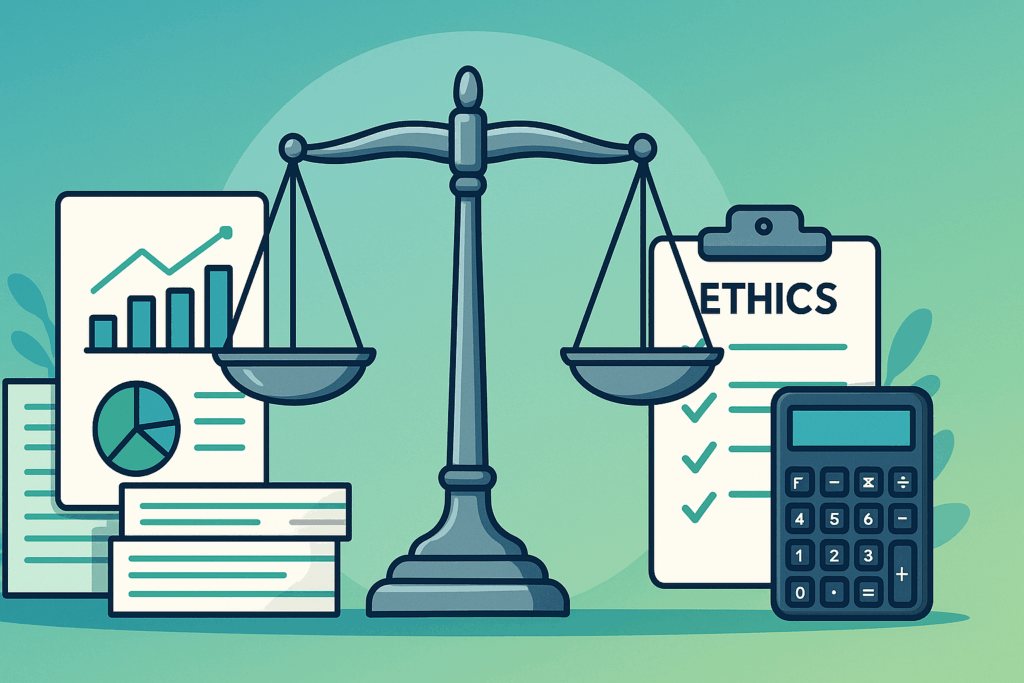
Balanced scale with calculator, financial reports, and ethics in accounting checklist symbolizing ethics in accounting
Uncategorized, Learn Accounting

8 Essential Lessons on Ethics in Accounting: Building Trust in Financial Reporting

Understanding Ethics in Accounting In the world of finance, where billions of dollars are exchanged daily, ethical practices in accounting serve as the backbone of trust and integrity. Ethics in accounting involves the moral principles that guide our behavior and decision-making in financial reporting, auditing, tax preparation, and more. Understanding these principles is vital for professionals, students, and business owners alike, as they navigate an increasingly complex financial landscape. The Importance of Ethics in Accounting in the Financial World Ethics in accounting is not just a set of guidelines; it is an essential component that impacts stakeholders at all levels. When accountants adhere to ethical standards, they contribute to the credibility of financial information, which is crucial for investors, clients, and regulatory bodies. The ethical implications of accounting practices can lead to broader social trust in financial markets, fostering an environment conducive to economic growth. Moreover, ethics in the accounting profession play a crucial role in preventing fraud and misrepresentation, which can have devastating consequences on businesses and the economy at large. By adhering to the principles of ethics and the international code of ethics, professional accountants can maintain professional integrity and mitigate risks. This commitment to ethical accounting practices not only protects the interests of clients and stakeholders but also ensures compliance with the latest accounting standards and regulations. By prioritizing ethics, accounting professionals contribute to a more stable financial environment, reinforcing the importance of ethics for accountants in their professional and business relationships. Key Elements of Ethical Accounting Practices There are several fundamental components that define ethical accounting practices. These include integrity, objectivity, professional competence, confidentiality, and professional behavior. Integrity involves being honest and straightforward in all professional relationships, while objectivity requires accountants to remain free from conflicts of interest and undue influence from others. Professional competence emphasizes the need for accountants to maintain their knowledge and skills to provide high-quality services. Confidentiality is paramount in the accounting industry, as accounting professionals must handle sensitive information with the utmost care. Ethics in accounting refers to the principles of ethics for professional accountants, which emphasize the importance of respecting the confidentiality of the information acquired during their work. Adherence to the code of ethics for professional conduct is essential, as it guides accountants in maintaining professional behavior. Furthermore, accountants must comply with relevant laws and regulations, as well as the international ethics standards set by the international ethics standards board. Avoiding any actions that could discredit the profession is crucial, as it reflects on the integrity of the accounting firm and the role in accounting. Ethics are essential for fostering trust and credibility in business practices, ensuring that the profession upholds its commitment to ethical standards in accounting and auditing. Why Accounting Integrity Builds Trust The Connection Between Trust and Financial Reporting Trust is the foundation of any successful financial relationship. When financial statements are prepared with integrity, stakeholders can rely on the information presented, allowing them to make informed decisions. Unethical accounting practices can erode this trust and lead to significant repercussions, including loss of business, legal penalties, and damage to reputations. Furthermore, the relationship between auditors and the companies they audit hinges on trust. An auditor’s credibility is reliant on their ability to conduct thorough and unbiased evaluations. If stakeholders perceive that auditors are compromised or lack integrity, it undermines the entire financial reporting process. Case Studies Highlighting Accounting Integrity Several notable cases in history underscore the importance of integrity in accounting. For instance, the Enron scandal, which involved the manipulation of financial statements and a significant breach of ethical conduct, led to the bankruptcy of the company and loss of thousands of jobs. The fallout from this scandal prompted a reevaluation of ethical standards and regulations in accounting, leading to the Sarbanes-Oxley Act of 2002. Conversely, companies like Johnson & Johnson have exemplified ethical practices in accounting, particularly during the Tylenol crisis in the 1980s when they transparently communicated with the public about product safety. Their commitment to integrity helped restore trust and maintain their brand’s reputation. Three Steps of Ethical Decision Making Identifying Ethical Dilemmas in Accounting Accountants often face ethical dilemmas that require careful consideration, highlighting the importance of ethics in accounting. Recognizing these issues is the first step in ethical decision-making. For instance, an accountant may be pressured to alter financial results to meet earnings targets, which poses a significant challenge within the accounting system. Identifying such pressure points is crucial as it sets the stage for evaluating potential courses of action, aligning with the five fundamental principles of ethics established by the ethics standards board for accountants.  Adhering to the code of professional conduct ensures that professionals uphold the technical and professional standards expected in the field. As changes in accounting practices occur, it is essential for accountants to stay updated with the latest accounting standards, including those from the financial accounting standards board and the international accounting standards board. The ethics in accounting include making professional or business judgments that not only comply with regulations but also reflect integrity and accountability, ultimately resulting in ethical outcomes in financial reporting. Situations such as these frequently arise from external pressures, including client demands or organizational culture. Understanding the ethical implications of these pressures is essential for accountants to navigate their responsibilities effectively. Evaluating Options for Ethical Solutions Once an ethical dilemma is identified, the next step in ethics and accounting is to evaluate the available options. Accountants working in the accounting field should consider the potential outcomes and consequences of each action. It is essential to recognize why ethics are important in accounting, as they guide professionals in making informed decisions. Consulting ethical guidelines, professional standards, and, when necessary, legal counsel can aid in assessing the best course of action. This careful consideration ensures the result of professional and business practices aligns with the principles of ethics in accounting, reinforcing the importance of maintaining integrity in the profession. Additionally, engaging in discussions with colleagues or mentors can provide valuable perspectives. Open dialogue can help clarify the

Business team discussing the 5 essential accounting principles every owner should know to improve financial reporting.
Uncategorized, Learn Accounting

5 Essential Accounting Principles: Win Big

Introduction: The Significance of Accounting Principles In the realm of business, financial reporting serves as the backbone for decision-making, strategic planning, and maintaining regulatory compliance. The importance of accounting principles cannot be overstated as these foundational guidelines ensure that financial statements reflect true and fair values, providing stakeholders with accurate insights into a company’s financial health. This article will explore key accounting principles, their role in fostering credibility, and their impact on compliance and decision-making for businesses, particularly small enterprises. Trust and Accuracy in Financial Reporting The trust that investors, lenders, and other stakeholders place in a company’s financial reporting is directly tied to the adherence to essential accounting principles. Understanding these principles is crucial, as they form the foundation of financial management and the accounting process. When businesses rigorously follow the 5 fundamental principles of accounting, they communicate transparency and reliability, which can lead to enhanced business relationships and opportunities for growth.  These core accounting principles include the going concern principle, the matching principle, and the revenue recognition principle, among others. In contrast, neglecting what are the 5 basic accounting principles can lead to misreporting, loss of trust, and potential legal repercussions. By adhering to accounting standards set by the accounting standards board and understanding the limitations of accounting, businesses can ensure their financial position remains robust, allowing them to continue to operate effectively. Moreover, a clear understanding of accounting principles can empower business owners and educators to make informed decisions based on accurate and timely financial data. This understanding not only aids in financial planning and budgeting but also serves as a vital educational tool for those training in the field of business management. Understanding Key Accounting Principles Cost Principle: Understanding the Value of Assets The cost principle, often referred to as the historical cost principle, is one of the essential accounting principles that states assets should be recorded at their purchase price rather than their current market value. Understanding what are the accounting principles like this one is crucial for anyone in the accounting profession. This principle is fundamental to the accounting concepts of financial accounting because it provides a clear and objective basis for valuing assets.  By adhering to these principles, businesses maintain consistency in their financial records, enabling them to evaluate financial transactions and analyze performance over time. Additionally, this approach aligns with the basic principles of accounting and supports compliance with international financial reporting standards. By applying this accounting method, organizations can ensure their accounting records reflect the true historical cost, which is vital for accurate financial reporting and decision-making from a business perspective. The implications of the cost principle extend beyond mere record-keeping. It also impacts how businesses assess their financial performance and value their assets for accounting purposes. For example, property purchased years ago may have appreciated significantly, yet it remains recorded at its original cost. This can potentially skew financial analysis unless adjusted for inflation or market changes. Revenue Recognition Principle: Timing of Income The revenue recognition principle is one of the 5 accounting principles that dictate how revenue is recorded in financial statements. This principle states that revenue should be recognized when it is earned, regardless of the cash flow timing. By adhering to this principle, accounting professionals ensure that the financial statements align with the fundamental accounting concepts, reflecting the true economic reality of transactions. This practice not only aids in maintaining compliance with GAAP principles but also enhances transparency for stakeholders, allowing them to assess a company’s financial activities accurately during a specific accounting period.  Matching Principle: Aligning Revenues and Expenses The matching principle is an essential accounting guideline that states that expenses should be recorded in the same period as the revenues they help to generate. This principle not only ensures a more accurate representation of a company’s financial performance but also facilitates better financial analysis and decision-making. By matching expenses to related revenues, businesses can observe the true profitability of their operations in a given period, which is one of the 5 key things to know about accounting. This principle ensures that costs incurred for producing a product are reflected in the same period when the product generates revenue, adhering to accounting principles of financial accounting. Such alignment not only helps stakeholders assess operational efficiency but also aligns with the concepts and principles established by the financial accounting standards board.  Full Disclosure: Transparency in Reporting The full disclosure principle mandates that all relevant financial information must be included in the financial statements or accompanying notes. This transparency is crucial for ensuring that stakeholders have access to all information necessary to make informed decisions regarding the company. Failure to disclose pertinent information can result in a lack of trust from investors and other stakeholders, ultimately harming a company’s reputation and financial standing. Adhering to key principles of accounting is essential; for example, disclosing potential liabilities or risks associated with operations helps provide investors with a clearer picture of the company’s overall risk profile and future performance potential. This approach not only fosters transparency but also reinforces the idea that the business will continue to operate effectively in the long run. In this context, understanding the basic accounting concepts is crucial, as these principles form the foundation for sound financial reporting, allowing stakeholders to make informed decisions. Conservatism in Accounting: A Cautious Approach The conservatism principle advises that while preparing financial statements, one should err on the side of caution. This means that potential expenses and liabilities should be recognized as soon as they are anticipated, while revenues should only be recognized when they are assured. This approach helps prevent overstatement of financial health and ensures that stakeholders are not misled by overly optimistic projections. The conservative approach is especially crucial in volatile industries, where market conditions can change rapidly. By adopting this principle, businesses can better prepare for unexpected downturns and manage stakeholders’ expectations regarding future performance. The Role of Accounting Principles in Building Credibility How Principles Foster Trust with Lenders Lenders rely heavily on financial statements to assess the creditworthiness of potential borrowers. By adhering

Business professionals look up at a futuristic mural representing the history of GAAP, with eco-friendly skyscrapers and colorful skies symbolizing accounting progress.
Learn Accounting

Uncover the Inspiring History of GAAP in 5 Eras of Progress

Introduction to GAAP The Generally Accepted Accounting Principles (GAAP) represent a collection of conventions, rules, and standards that shape the financial reporting of organizations. These principles serve as the backbone of transparency and consistency in financial statements, guiding accountants and auditors in their work. Understanding GAAP is vital for professionals, educators, and anyone involved in financial dealings, as it ensures that financial statements are prepared and presented in a manner that is understandable and comparable across different entities. In this article, we will delve into the historical evolution of GAAP, tracing its origins, significant milestones, and its pivotal role in modern financial reporting. By examining the development of these standards from their inception to the present day, we aim to highlight the importance of GAAP in maintaining the integrity of financial information in the business world. Early Roots of Accounting Standards (Pre-1930s) Primitive Accounting Practices The concept of accounting dates back thousands of years, with primitive forms of record-keeping emerging in ancient civilizations such as Mesopotamia, Egypt, and China. Early accountants relied on simple tally sticks and clay tablets to record transactions, which were often limited to basic exchanges and did not account for the complexities of burgeoning trade networks. These rudimentary systems laid the foundation for more sophisticated methods of tracking financial activities, ultimately leading to the establishment of formal accounting standards. The emergence of double-entry accounting in the 15th century marked a significant turning point, providing a more reliable framework for documenting financial transactions and ensuring greater accuracy in financial reporting. However, these early accounting methods lacked uniformity, leading to discrepancies and misunderstandings among stakeholders. As commerce expanded, particularly during the Industrial Revolution, the need for a standardized approach became increasingly apparent. This growing complexity prompted the gradual development of formal accounting principles, a process that would eventually culminate in the establishment of Generally Accepted Accounting Principles (GAAP). The history of GAAP reveals the evolution of these standards, which serve as a set of rules designed to enhance the consistency and transparency of financial reporting across different industries. Influence of Early Business Needs As commerce expanded, particularly during the Industrial Revolution, the demand for clear and consistent financial reporting grew exponentially. The burgeoning industrial sector necessitated a shift from informal bookkeeping practices to more systematic approaches, as businesses began adopting various accounting practices tailored to their individual needs. However, this lack of standardization posed significant challenges for investors, regulators, and the public, leading to a crisis of confidence in the financial markets. The absence of a cohesive framework for financial reporting allowed businesses to manipulate their financial statements, creating an environment ripe for misrepresentation and deception. The history of GAAP reveals that these issues underscored the pressing need for a more structured approach to accounting. Stakeholders, including investors, accounting professionals, and regulatory bodies, recognized that a standardized set of principles was essential to ensure the reliability and comparability of financial information across different entities. This recognition spurred the formation of various accounting organizations aimed at developing acceptable accounting practices. For instance, the Committee on Accounting Procedure, established in the 1930s, was one of the first attempts to address the inconsistencies in financial reporting, laying some groundwork for what would eventually evolve into the Generally Accepted Accounting Principles (GAAP). The Great Depression and the Birth of Formal Standards (1930s) Economic Factors Leading to Regulation The stock market crash of 1929 and the subsequent Great Depression underscored severe deficiencies in financial reporting practices, thereby illuminating the urgent need for reform in the accounting profession. Investors faced enormous losses, which were exacerbated by fraudulent financial statements and misleading disclosures that failed to adhere to any standardized guidelines. This economic turmoil prompted the U.S. government to intervene, establishing regulatory frameworks aimed at protecting investors and restoring confidence in the financial markets through the implementation of generally accepted accounting principles (GAAP). Recognizing the pressing need for oversight and regulation, the Securities and Exchange Commission (SEC) was formed in 1934. One of its primary objectives was to bring order to financial reporting and ensure that corporate financial statements were accurate, reliable, and reflective of true economic conditions. The SEC’s actions were pivotal in the establishment of formal accounting standards, which marked a significant turning point in the history of GAAP.  Moreover, the history of GAAP is intertwined with the origins of GAAP in the U.S., shaped by external pressures such as the Securities Act of 1933, which mandated the disclosure of financial information to protect investors. The SEC and GAAP development have since evolved, with the introduction of the Governmental Accounting Standards Board (GASB) to address the specific needs of governmental entities. This division of responsibilities has allowed for tailored standards that better reflect the unique financial reporting requirements of public sector organizations. Formation of Initial Standards In response to the regulatory environment created by the Securities and Exchange Commission (SEC), the American Institute of Accountants, which would later evolve into the American Institute of Certified Public Accountants (AICPA), took a proactive stance to address the growing demand for standardized accounting practices. This led to the establishment of the Committee on Accounting Procedure (CAP) in 1939, a pivotal moment in the history of GAAP.  The Committee on Accounting Procedure (1939–1959) Establishment and Objectives The Committee on Accounting Procedure (CAP), established in 1939, was instrumental in the early stages of formulating Generally Accepted Accounting Principles (GAAP) in the United States. The primary objective of the CAP was to identify and address a wide array of accounting issues that emerged during an era of rapid economic change. By developing solutions aimed at enhancing the consistency and reliability of financial reporting, the CAP laid the groundwork for a more structured approach to accounting standards. This foundational work was critical in providing clarity and guidance to accountants, ultimately influencing the trajectory of accounting practices in the U.S. The CAP operated under the premise that accounting principles must be adaptable to the evolving nature of business transactions while upholding a commitment to transparency and reliability. This flexible approach facilitated the gradual integration of innovative principles and practices into the existing framework, setting

A woman studying printed tax documents at a desk, symbolizing CPA Exam Tax Deductions Explained.
CPA Exam, Learn Accounting, REG

CPA Exam Tax Deductions: Unlock Max Savings

Aspiring CPAs preparing for the Regulation (REG) section of the Uniform CPA Exam must grasp a broad spectrum of tax law concepts. One of the most critical areas tested is the treatment and application of tax deductions. This article offers a detailed CPA exam tax deductions explained guide. CPA Exam Tax Deductions Explained Tax deductions reduce taxable income, directly lowering the amount of income subject to tax. They play a central role in both business and individual tax planning. On the CPA Exam, particularly in the REG section, candidates are expected to identify which deductions apply to various types of entities, distinguish deductions from credits, and assess how these tax benefits impact adjusted gross income (AGI) and overall taxable income. This foundational understanding is not just theoretical but is applied to scenario-based questions across multiple exam blueprints. A commonly tested area is the Section 199A qualified business income (QBI) deduction. This provision allows eligible taxpayers to deduct up to 20% of their QBI, which is income earned through certain types of pass-through entities. The deduction is subject to several limitations based on income level, entity type, and whether the business is considered a specified service trade or business (SSTB). This concept is tested frequently on the REG exam because of its complexity and relevance to sole proprietors, partnerships, S corporations, and certain trusts. Understanding how and when the QBI deduction applies is essential to passing the CPA REG section. For instance, knowing how this deduction affects taxable income, what types of income are excluded (e.g., capital gains), and how to calculate the allowable deduction under various scenarios are all critical skills assessed by the exam. What is QBI Deduction? The QBI deduction, covered under Section 199A, applies to income from qualified trades or businesses, excluding capital gains, dividends, and certain other investment-related income. A common exam question may ask, “Does Schedule C qualify for Section 199A?” The answer is yes, as long as the taxpayer operates a qualified trade or business and meets the income and threshold criteria. Safe Harbor Rules and Qualified Trade or Business Examples Safe harbor provisions often appear on the REG exam. Specifically, the safe harbor for rental real estate helps determine whether rental activity qualifies as a trade or business under Section 199A. Candidates must know when does a business qualify for SSTB (specified service trade or business), as these classifications directly impact QBI eligibility and phase-out thresholds. Qualified trade or business examples CPA exam content may include scenarios such as consultants, real estate professionals, and eligible service providers. Understanding these classifications is critical for maximizing your REG exam performance. Business Interest Limitation and Phase-Outs Another key topic is the CPA REG exam business interest limitation under IRC Section 163(j). This provision limits the deductibility of business interest expenses to a percentage of adjusted taxable income. Understanding the impact of these limitations on small business entities is vital. Equally important is having the Section 199A deduction phase-out explained thoroughly. This concept requires careful attention to income thresholds and phase-out rules based on filing status and SSTB classification.     Final Thoughts on CPA Exam Tax Deductions Explained With the CPA exam tax deductions explained in a clear and structured format, REG candidates can approach this topic with greater confidence. From QBI deduction intricacies to the nuances of SSTBs and interest limitations, mastering these areas improves your chances of success. Stay current with evolving tax guidance, focus on conceptual clarity, and use authoritative CPA exam resources to ensure you’re fully prepared. Whether you’re wondering if Schedule C qualifies for a QBI deduction or trying to understand the business interest limitation better, this guide serves as a reliable companion in your CPA exam journey. Embrace these insights, and let your preparation reflect the precision and confidence of a future CPA.

Pet grooming business owner reviewing cash flow statements at her desk with a dog on a grooming table in the background
Learn Accounting

Understanding Cash Flow: Master Financial Wins

Understanding cash flow is essential for making informed financial decisions. Whether you’re a student, a business owner, or a professional like Daniel CPA, mastering cash flow is critical for long-term success. This comprehensive guide breaks down the essentials of cash flow, providing practical tools for interpreting a cash flow statement and planning effectively. You’ll gain clarity on cash inflows and cash outflows, learn to build accurate financial statements, and understand how to apply that knowledge to real-world scenarios. If you’re running a pet grooming business, for example, proper cash flow tracking helps manage inventory costs, payroll, and equipment upgrades. This guide offers strategies for managing both personal and business finances with confidence. Whether you’re budgeting for your household or preparing for a business expansion, knowing how to read and act on cash flow data empowers you to stay proactive. Strong financial habits begin with understanding the movement of cash—this guide helps you start there. What is Cash Flow? Definition and Importance Understanding cash flow means recognizing how money moves in and out of your business or personal finances and why that movement matters. For any entity, cash flow is the foundation of financial health. Whether you are managing a dog spa business, launching a grooming service, or facing the accounting challenges of pet stores, knowing your cash position at any moment helps you make smarter financial decisions. Cash flow reflects the liquidity of your operations. A steady inflow ensures that obligations such as payroll, rent, and inventory costs are met, while a weak or negative flow may indicate trouble. Monitoring where money comes from and how it is used helps prevent shortfalls. With proper cash flow management, you can plan for growth, cover expenses, and protect your business during slow periods. It is important to distinguish between cash flow and profit. Profit refers to revenues minus expenses and may appear healthy on paper. However, cash flow focuses solely on actual money received and spent. For example, a dog spa business may report strong profits, but if payments from customers are delayed and vendor bills are due, that business may still struggle to keep its doors open. Understanding cash flow is especially important when looking to expand or finance a new venture. If you are wondering how to get a loan to buy a pet grooming business, lenders will expect to see detailed cash flow statements that demonstrate your ability to repay the loan. No matter how well you price your services or plan for growth, cash flow determines whether you can meet short-term obligations and maintain long-term stability. Cash flow also plays a central role in solving the accounting challenges of pet stores. From managing inventory turnover to balancing supplier terms and seasonal demand, a solid grasp of cash flow can help business owners stay ahead. Keeping a close eye on cash inflows and outflows helps improve planning, reduce financial stress, and increase operational efficiency across all types of service businesses. Components of Cash Flow Types of Cash Flow Understanding cash flow begins with recognizing its three main components: operating, investing, and financing activities. Each plays a distinct role in the financial health of a business and is especially relevant in niche industries like pet grooming or retail.  Operating Cash Flow: This represents the cash generated from a business’s everyday activities. This includes cash received from customers and payments made for routine expenses such as supplies, wages, and utilities. For example, when a dog spa business collects payments for grooming services or sells pet products, that revenue is categorized as operating cash flow. Many owners use tools like QuickBooks for dog groomers to monitor these transactions in real time. Investing Cash Flow: This covers the inflows and outflows associated with purchasing or selling long-term assets. For pet grooming businesses, this might include buying grooming equipment, renovating the storefront, or even selling an old delivery van. These activities can result in negative investing cash flow in the short term, but they often reflect growth-oriented decisions. Financing Cash Flow: This includes all transactions related to funding the business, such as loans, repayments, or equity contributions. A pet store owner securing financing to expand or upgrade their business software for pet groomers would see that loan recorded under financing cash flow. This also includes repaying borrowed funds or distributing profits to investors. In pet business accounting, these three components interact in complex ways. A grooming shop may show strong operating cash flow while having negative investing cash flow due to a recent expansion. Meanwhile, financing cash flow may be positive if a loan was secured to support that investment. Understanding cash flow at this granular level is essential, especially when navigating the accounting challenges of pet stores or evaluating how to value a pet grooming business. By gaining clarity on how these cash flows work together, pet business owners can make smarter decisions, maintain liquidity, and set a path for sustainable growth. Cash Flow Management Strategies Techniques for Effective Cash Flow Management Budgeting: A fundamental aspect of understanding cash flow and ensuring long-term financial health. Creating a detailed cash flow budget allows businesses, especially niche operations like dog grooming small businesses, to anticipate their cash inflows and outflows. By estimating these figures, owners can plan for shortfalls, build cash reserves, and adjust spending when necessary. Effective budgeting forms the foundation of good bookkeeping for pet businesses, aligning income with expenses and helping owners stay on track with financial obligations. Forecasting: Takes cash flow management a step further by using tools such as trend analysis, seasonal adjustments, and historical data to predict future cash positions. This practice is critical in industries with fluctuating revenues like pet grooming. A sound knowledge of accounting helps business owners recognize patterns and forecast with greater accuracy, enabling them to prepare for lean months or periods of increased demand. Monitoring: Involves actively tracking financial data using software or spreadsheets, making real-time updates to reflect the business’s liquidity. For pet business owners with limited accountant basic knowledge, utilizing automated systems can simplify this process.

Petty cash logbook, calculator, dollar bills, and coffee on a desk — visual concept for petty cash reconciliation
Learn Accounting

Petty Cash Reconciliation: Master the Steps

Understanding Petty Cash Reconciliation What is Petty Cash? Petty cash is a small amount of cash that businesses keep on hand for minor expenses that are too small to warrant issuing a check. This cash fund is typically managed by an employee known as the petty cash custodian. The amount kept in petty cash can vary, but it is generally between $50 and $500, depending on the organization’s needs. The purpose of petty cash is to facilitate quick payments for everyday operational costs such as office supplies, travel expenses, and employee reimbursements without the need for formal documentation that comes with larger transactions. Petty cash reconciliation can be an effective tool for managing small expenses, but it requires careful oversight to prevent misuse or theft. It operates under a system where expenditures must be documented with receipts, and the fund must be reconciled regularly to ensure that the physical cash on hand matches the documented transactions. This balance between convenience and accountability is essential for maintaining the integrity of the petty cash system. Importance of Petty Cash reconciliation in Business The significance of petty cash in a business cannot be overstated. It provides immediate access to funds for unexpected expenses or urgent needs, thereby enhancing operational efficiency. Without a petty cash fund, businesses may face delays in fulfilling minor financial obligations, which can disrupt workflows and impact employee morale. Moreover, a petty cash reconciliation helps maintain a clear separation between personal and business expenses, as employees can use these funds for business-related purchases only when properly documented. Additionally, petty cash serves as a valuable tool for expense tracking. By maintaining detailed records of petty cash transactions, businesses can gain insights into their spending patterns, identify areas for cost-saving, and ultimately make better financial decisions. This visibility can also help in budgeting for future expenses, ensuring that the organization remains financially sound. How Petty Cash Works The operation of a petty cash system involves several key components. First, the business will establish a petty cash fund, which is an initial amount of cash set aside for small purchases. This fund is typically replenished by submitting expense reports that show how the cash has been spent. Each transaction from the petty cash fund must be documented with receipts, which serve as proof of the expenditure and ensure accountability. To maintain control over the petty cash fund, the custodian is responsible for overseeing the cash, ensuring that it is used appropriately, and keeping meticulous records of all transactions. The custodian must reconcile the fund regularly — typically monthly or bi-weekly — to confirm that the amount of cash on hand plus any receipts matches the initial petty cash amount. This petty cash reconciliation process is crucial for preventing fraud or errors in accounting. Steps for Reconciliation Step 1: Gather Your Records The first step in reconciling petty cash is to gather all relevant records. This includes the petty cash ledger, which tracks all transactions, and any receipts or documentation related to purchases made from the petty cash fund. It is important to ensure that all transactions for the reconciliation period are accounted for to avoid discrepancies. Organizing these records can simplify the petty cash reconciliation process. Using a spreadsheet or accounting software can help in maintaining a clear record of transactions, making it easier to identify patterns in spending and track the remaining balance in the petty cash fund. Step 2: Count the Cash Once all records are gathered, the next step is to physically count the cash in the petty cash fund. This should be done in a secure environment to prevent any loss or misappropriation of funds. The cash count is essential to verify that the amount on hand matches the records, ensuring that the petty cash system is functioning as intended. It is advisable to have a second person involved during the cash count to provide an additional layer of oversight. This practice helps to deter any potential misuse of funds and ensures greater accuracy in the petty cash reconciliation process. Step 3: Review Receipts and Documentation After counting the cash, the next step is to review all receipts and documentation associated with the petty cash transactions. Each receipt should match a corresponding entry in the petty cash ledger, and any discrepancies should be noted. This review ensures that all expenditures are legitimate and that proper documentation is maintained. Additionally, it is crucial to check that the receipts are clear and provide adequate information, including the date, vendor, and purpose of the expense. This level of detail is important for accurately reporting expenses and for auditing purposes should the need arise. Step 4: Compare Cash on Hand to Ledger With the cash counted and receipts reviewed, the next step is to compare the total cash on hand to what is recorded in the petty cash ledger. The sum of the cash on hand plus the total of the receipts should equal the original amount of the petty cash fund. If there is a discrepancy, it must be investigated to determine the cause, whether it be an unrecorded transaction, an error in counting, or potential theft. This comparison is not just a routine task; it plays a vital role in ensuring the accuracy of the overall financial records of the business. Regular discrepancies can signal underlying issues that need to be addressed, such as inadequate oversight or employee training regarding petty cash policies. Step 5: Identify Discrepancies If discrepancies are found during the petty cash reconciliation process, it is essential to identify their source. This could involve reviewing individual transactions more closely, checking for missing receipts, or discussing with the petty cash custodian to gain clarity on any questionable transactions. Understanding the root cause of discrepancies is critical, as it can help prevent future issues. Sometimes, discrepancies may arise from honest mistakes, such as miscounting cash or failing to record a transaction properly. However, if there is a suspicion of fraudulent activity, it may be necessary to conduct a more thorough investigation and implement stricter

Scroll to Top